Letter to Mobility Subcommittee March 31, 2026, Culver City
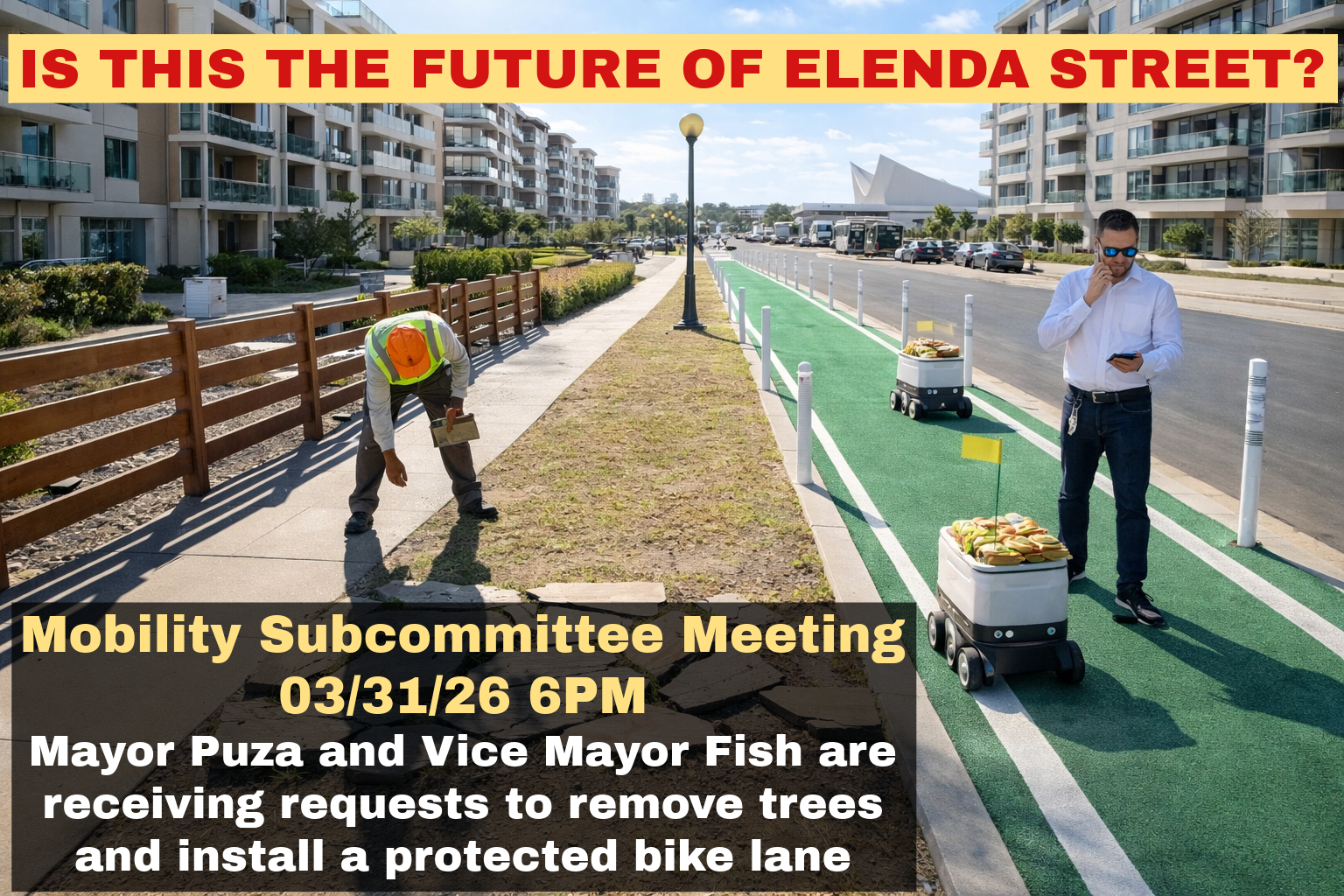
Follow the Data: Protect Elenda Street and Respect the Study
Dear Members of the Mobility Subcommittee,
I am writing to express strong support for the current findings of the Tri-School Safety Study and to urge you to keep the process grounded in data, professional analysis, and the realities of our neighborhood.
The consultants hired to evaluate this area have already collected extensive data and reached a clear conclusion: protected bike lanes are not appropriate for these residential streets. That conclusion should carry weight. Engineering decisions, especially those affecting safety, infrastructure, and neighborhood character, must be driven by evidence, not by outside pressure or ideological preference.
There is now a coordinated push from advocacy groups, many from outside our neighborhood, to override those findings. Their proposal would come at a significant cost to our community, including:
*Removal of mature street trees, particularly the established ficus canopy, identified in the City’s own Urban Tree Master Plan as among the highest contributors to carbon sequestration, air quality improvement, and public health benefits in Culver City, which would result in reducing shade, increasing heat, and degrading neighborhood air quality
*Loss of residential parking, which would disproportionately impact families, senior citizens, and individuals with disabilities who rely on close-access parking. Most homes on Elenda Street were built without driveways, and the rear alleyways, long in a state of neglect and disrepair, are not viable alternatives for safe or accessible use, particularly for those using walkers, wheelchairs, or assisting children and elderly family members
These are not minor tradeoffs. They are permanent and unnecessary given the available data.
Just as importantly, the December 2025 data provides critical context that should guide decision-making:
*Braddock Drive and Elenda Street intersection on a school weekday has approximately 1,064 vehicle movements compared to just 28 bicycles, while pedestrian activity is significantly higher at 464 individuals.
*The highest volumes of automobile traffic in the Elenda Historic Neighborhood District occur during end-of-day commuter rush hour, not during student arrival or dismissal times
*The Ballona Creek bike path is, by far, the most heavily used route for students traveling by bicycle and already functions as the primary safe corridor
*There are two predictable periods of increased automobile volume each day, largely driven by the school district’s permit students, approximately 30% of the student population, many of whom commute from outside the city.
*These peak periods occur on roughly 180 school days per year and are highly predictable, making them appropriate for targeted operational management rather than permanent structural changes to the street.
*Outside of these short and defined windows, the data shows that Elenda Street consistently functions as a quiet residential street, reflecting its intended design and long-standing neighborhood character.
These facts point clearly toward where efforts should be focused.
We ask you to direct the team working on the Tri-School Safety Study to remain aligned with the data and professional analysis already completed, which does not support the inclusion of protected bike lanes on these residential streets.
You have consistently been a champion for safe routes to school—for walking, biking, transit, and driving—and we appreciate that leadership. We are confident you will continue to support solutions that are grounded in evidence and that reflect how students and families are actually moving through the neighborhood today.
Instead of forcing infrastructure where it has been deemed inappropriate, the City should invest in and enhance the Ballona Creek bike path by making it safer, cleaner, greener, and better lit.
In addition, there is a clear and practical opportunity to improve traffic flow and reduce congestion on Elenda Street during the two, short, predictable times only 180 days annually: The school district should open and better utilize its access gates, allowing for more distributed vehicle movement throughout the area.
This would significantly reduce pressure on Elenda Street by dispersing traffic, rather than concentrating it in a residential street.
Everyone shares the goal of improving safety for students and families. But “all options” does not mean ignoring professional analysis or misreading the data. Responsible planning means aligning solutions with how people are actually moving through the area.
We are confident you will ensure that the study’s recommendations reflect real-world conditions, not external pressure.
In short:
Data—not vibes—should guide these decisions.
Please support the integrity of the study, respect the consultants’ conclusions, prioritize improvements where they will have the greatest impact, and protect our neighborhood from changes that are neither supported by evidence nor aligned with community needs.
Thank you for your time and consideration.
Sincerely,
Culver City Residents
and Elenda Historic Neighborhood District
To: freddy.puza@culvercity.org, bubba.fish@culvercity.org, lisa.soghor@culvercity.org, yanni.demitri@culvercity.org, mate.gaspar@culvercity.org, andrew.maximous@culvercity.org, gabriel.barreras@culvercity.org, seth.contreras@culvercity.org, henry.phipps@culvercity.org, alicia.ide@culvercity.org, brent.arny@culvercity.org, chief.police@culvercity.org, pipteam@culvercity.org, boardmembers@ccusd.org, Alfonsojimenez@ccusd.org, city.clerk@culvercity.org, city.attorney@culvercity.org, odis.jones@culvercity.gov, nick.zornes@culvercity.gov, lea.eriksen@culvercity.gov, public.comment@culvercity.org, city.council@culvercity.org