Elenda Street Needs Targeted Solutions—Not Permanent Changes
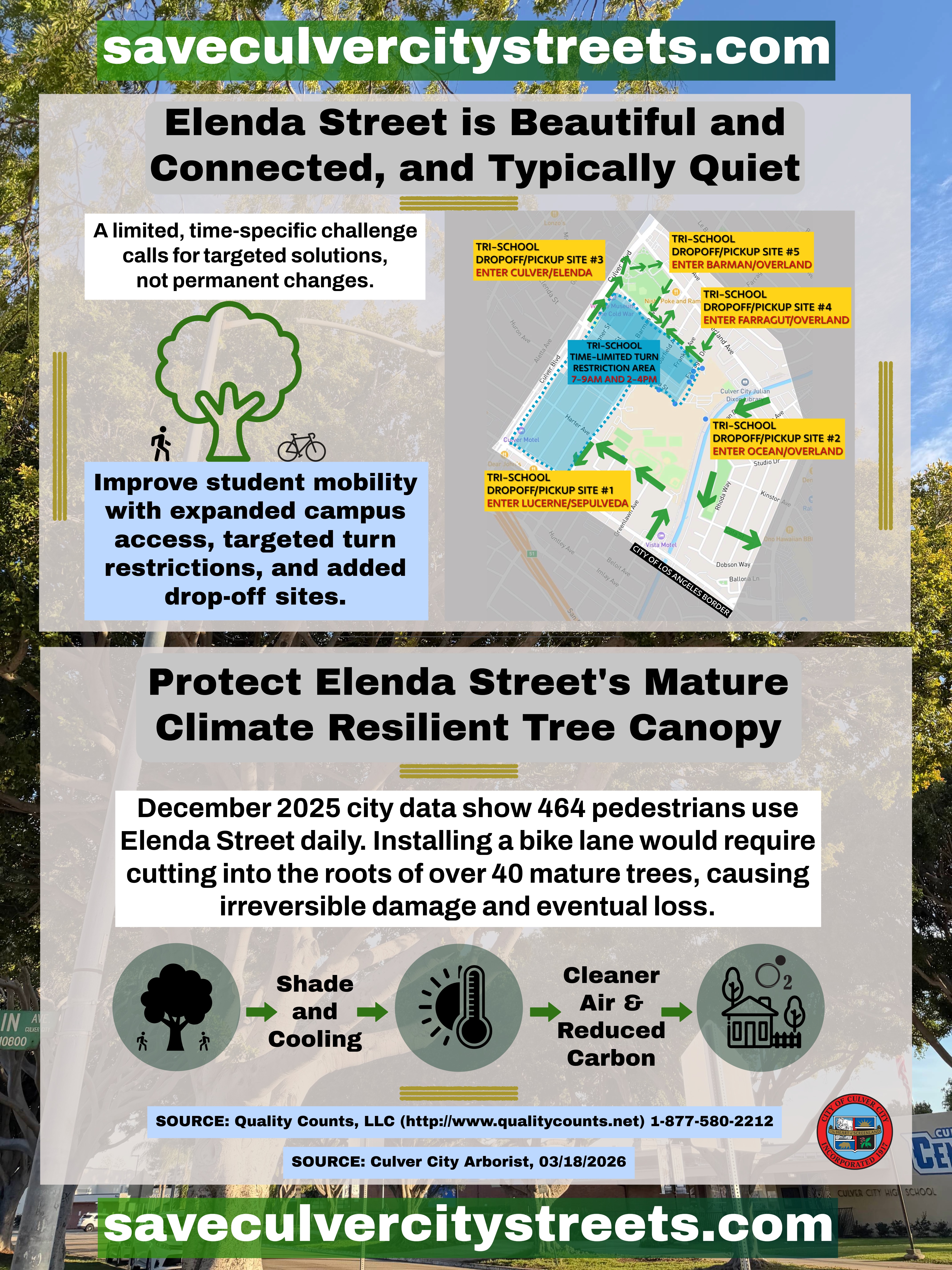
Elenda Street is a beautiful, connected neighborhood street that functions well for pedestrians and cyclists most of the time. The issue being discussed is not a full-day problem—it is a predictable, school-time traffic pattern that occurs during drop-off and pick-up hours.
City data from December 2025 show that Elenda sees relatively low bicycle usage, especially when compared to Ballona Creek, which serves as Culver City’s primary student cycling corridor. This raises an important question: are we solving the right problem in the right place?
The proposed bike lane on Elenda would come with a significant cost. Installing it would require cutting into the roots of over 40 mature trees. According to arborist analysis, this would cause irreversible damage and likely lead to their eventual loss. These trees are not incidental—they provide shade, cooling, and air quality benefits to residents and students alike.
Rather than making permanent structural changes to a street that already works, the smarter approach is to address the specific challenge directly.
Targeted solutions exist:
-
Expanding school campus access points
-
Implementing focused turn restrictions during peak times
-
Creating additional drop-off and pick-up locations
These strategies reduce congestion where and when it actually occurs—without sacrificing the environmental and neighborhood benefits already in place.
This is not a case for overhauling Elenda Street. It is a case for precision.
A predictable, time-specific issue calls for targeted solutions—not permanent changes.